HELLO, I AM JOSH BALL

Thursday, June 30, 2011

Outdoor wall aquaponic system (update: 6/29)

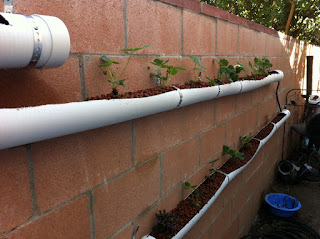
So I finished tying together the system, and got all the kinks out. After a day of letting the system settle we planted a bunch plants; strawberry's and tomatoes. We also planted a flower that attracts bees, it's called Cuphea "La Chiquita"  Here are some new pics!


Here are the tomatoes planted nicely in a row!

 Here are some great pics of the
strawberry's we planted


 Soon to be a big tomato plant!


Here are the 13 strawberry plants


Here is the Cuphea flower


Saturday, June 25, 2011

Outdoor wall aquaponic system

   So here is my outdoor aquaponic system just installed today. It is installed on a side yard and it has 30ft of grow-able bed and is linked to a 55gl. drum for my fish. It takes up about 4 sq. feet on the ground, with the rest of the system on the wall, out of the way. Here are some of the pics...


Friday, June 24, 2011

Indoor wall aquaponic system


     This is my version of a wall aquaponic setup. It works the same way as my aquaponic system outside, this one is just much smaller. One or two small fish will keep the Nitrogen Cycle going. All the plants I have chosen are low light indoor plants, providing increased oxygen for the household. This was a really fun project and I have a few ideas for improving my design, but we tested the system and it worked flawlessly! Here are some pics, enjoy!


Thursday, June 23, 2011

Two bed aquaponic system

     So here are some pictures from my aquaponic system. I am still waiting for the Nitrogen Cycle to complete itself, but after testing the water each day, looking at: Temperature, Salinity, pH, Ammonia, Nitrite, and Nitrate levels, I am documenting a noticeable difference in the Nitrite levels. There is also a rise in Nitrate levels, due to the fact that I used a few gallons of water from my Dad's pond (established for over five years) and cycled that through my system. I read a piece an kick starting the bacteria needed for Nitrite growth by adding water from an already established pond or aquaponic system. By doing so you introduce all the parts needed for a full cycle. This does not mean that the next day, walla! You have a completely cycled aquaponic system producing at 110%!!! It does however provide a foundation for the correct bacteria to grow, and that is a great starting point!


Friday, June 17, 2011

New Egg Layers!

I am proud to say that the first egg has been laid by our batch of four month old chickens!!! I have included an egg laid by our adult chickens for comparison.


The Need for Water Checks and Filters

     Being one who likes to jump head first into a project, how could I treat my Sustainable Living Project any different!? While working on my Aquaponic System I quickly found out I need to add a filter and use a water test kit. I realized this of coarse when the water got really cloudy and my fish started looking stressed. I didn't help the situation by adding fish food to the tank to help  kick start the Nitrogen Cycle, which makes this whole process work. Here are the changes I made to balance my Aquaponic System, but first let me just say that although I need to make adjustments to  the system my vegetables are growing at an extrordinary rate!  An Aquaponic System is a great way to grow vegetables and fish at the same time!
   
     The first change I made was adding a filter to the system. In my Aquaponic System I am using a flood and drain method in two 3'x3'x 5" grow beds filled with expanded clay to grow my vegetables. This in itself acts as a biological filter, but that does not filter out all the smaller, fine particals that will flow back to the stock tank. This adds to the buildup of toxic chemicals, and will stress or kill your fish. I did not buy a filter from the store. I took a one galon water bottle and cut off the top. Then I filled the bottle with gravel on the bottom expanded clay in the middle, and peet moss on top. I took the drain tubes from the grow beds and positioned then so that the draining water flows through my filter. With holes in the bottom, I had a successfull filter, and it went right to work! After only a few hours the water visiblity increased greatly. By morning the water was clear.
  
      The second and equally important change I made was testing the chemical levels in my water. I went to our local fish store, Tats, and bought a test kit that tests for, pH, Ammonia, Nitrites, and Nitrates. (Sound familiar...it should! three out of the four chemicals tested are parts of the Nitrogen Cycle!) I tested my water and found that the Ammonia level was at 4.0 ppm. Anything over 1.0 is bad for your fish, so 4.0 ppm is EXTREMELY bad for the fish! I immeadiately did a 50 percent water change and when I checked the Ammonia level in the morning it was just barely above 1.0 ppm. The water is now clear and the fish look very happy.

        Overall here is what you should take away from this posting:
  1. There should ALWAYS be a filter somewhere in your system.
  2. Get a water test kit and learn it, use it, make it your best friend. Also take diligent notes. When you ask for help, handing someone a detailed notebook on the chemical water levels in your Aquaponic System is a great start!
  3. The Nitrogen Cycle does not take much to get started! Do not underestimate the power of Mother Nature. You can create a large amount of ammonia with just a few feeder fish and some fish food! Large amounts of ammonia will kill your fish!
  4. Be proactive with your Aquaponic System. Take a few minuets each day to check and make sure your system is running optimally. Don't let what would be tiny adjustments turn into full blown problems that require immediate responses. 
       Remember using your Aquaponic System is supposed to be fun, as well as a fantastic way to grow your food! I am quickly moving from a hobby in Aquaponics to a full obsession. My entire life I have been working in fish tanks and ponds helping my Dad, creating different habitats for amphibious life, and marine life. Many times using the Nitrogen Cycle as our biological filter. I remember saying "Dad i don't want change out any more water!..." among many other complaints, but now I find myself recalling these memories in the pursuit of perfecting my Aquaponic System. I am greatful for my lessons, but believe me when I say there is always something new to learn! There are countless ways to create and use Aquaponic Systems, so go out and start your own!

Monday, June 13, 2011

My aquaponic system is working with just $20 of feeder fish!

      I plan on showing you how little fish effluent it takes to make your veggies grow.  First lets recap on how the aquaponic system works. The water that the fish are contained in, either tanks or ponds, is pumped to your vegetables. The nutrients in the water, provided by the fish (and fish food) is absorbed by the plants; the filtered water then drains or is pumped back to the fish. This system works because of the Nitrogen Cycle; it is never ending as long as there are fish and foliage.
     While waiting for a batch of new trout I had a tray of seedlings that were ready to be transplanted. I decided to move the plants to the aquaponic system and use feeder fish to run the cycle. I went out and bought twenty dollars worth of feeder fish and put them in my 320 gallon stock tank. Within three days I had serious results!
     The seedlings have been in 2 3x3 grow beds for 3 days and there is about an 1 1/2 in. growth. I am growing different pepper plants, squash, beans, chives and tomatoes.

     Here you can see the bean and pea plants.  Once we transplanted them to the aquaponic system they just took off!


    Check out these peppers. Three days ago the leaves were just barely out of the rockwool cubes. Now they are sprouting new leave!


     These squash plants are doing really well!. One of them was damaged in the move, but after a little extra attention I'm happy to say it has plenty of new growth!
 
  
     Here are the feeder fish enjoying a little lunch.


     Once I have my aquaponic system stocked with trout or talapia, there will be even more growth. But as you can see, even a few fish can produce enough nutrients for your vegetables. This is a fantastic method to feed yourself and those around you. There is no need for crop rotation or rest period for soil. Once your crop is ready to eat you can pull your plants and plant a new crop in the same day. The best part about using an aquaponic system is that everything you grow is healthy food!There are no chemical additives, there is no processed this, and partially hydrogenated that; this is all natural. Remember you are what you eat!